Generally, supratherapeutic warfarin dosing in low risk patients without bleeding does not require active reversal. Warfarin should be withheld until the target INR is restored.
Vitamin K should be considered for patients with excessively raised INR or in the groups discussed below in addition to replacement or the inactivated factors.
In clinically significant bleeding or in high risk patients, use of Prothrombinex is reasonable. It is also indicated if reversal is required for planned invasive procedures such as surgery.
NZ Blood has moved from Prothrombinex to Beriplex
The dosages are much the same…
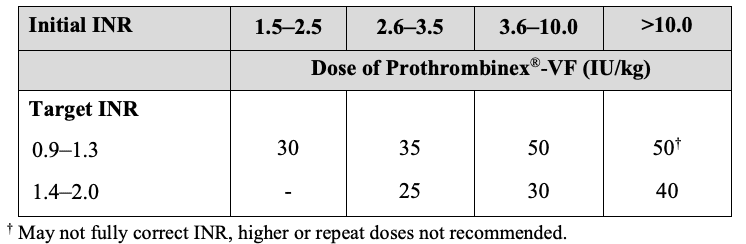
In life-threatening or critical organ haemorrhage, FFP should be given.
Mechanism
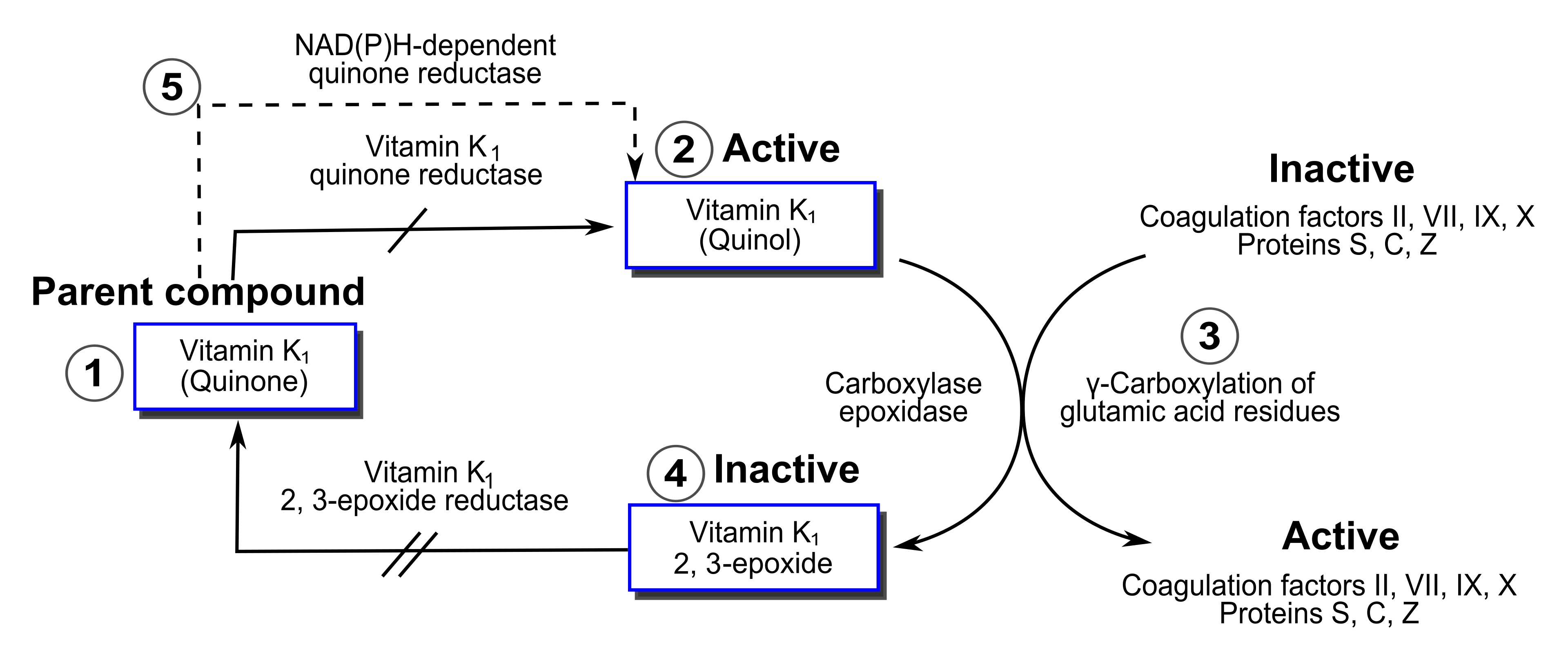
Warfarin inhibits vitamin K epoxide reductase (VKOR), and to a lesser extent vitamin K reductase, arresting the normal vitamin K cycle. The subsequent reduction in active vitamin K limits gamma-carboxylation of the vitamin K dependent factors.
 12
By RicHard-59 - Own work, based on (link to Archive), CC BY-SA 4.0, link.
12
By RicHard-59 - Own work, based on (link to Archive), CC BY-SA 4.0, link.
The form of vitamin K (phytomenadione) used for warfarin reversal is the parent compound and requires a single activation step which is catalysed by an unidentified warfarin resistant quinone reductase.
Links:
- NZBlood - Warfarin Reversal
- New Zealand Blood Service. Transfusion Medicine Handbook [Internet]. 3rd ed. NZBS; 2016. Link
- Mosnier LO. Warfarin, a juggler’s demise. Blood. 2018 Jun 21;131(25):2742–3. doi:10.1182/blood-2018-05-843151
- Hirsh J. Reversal of the Anticoagulant Effects of Warfarin by Vitamin K1. Chest. 1998 Dec;114(6):1505–8. doi:10.1378/chest.114.6.1505
Footnotes
-
1 Phytomenadione (vitamin K), 2 Vitamin K hydroquinone (vitamin KH2), 4 Vitamin K epoxide (vitamin KO) ↩
-
Vitamin K1 (quinone) refers to phytomenadione, it is an inactive form of vitamin K. The =O groups give it the common classification of quinone. Its full IUPAC name is 2-methyl-3-[(E,7R,11R)-3,7,11,15-tetramethylhexadec-2-enyl]naphthalene-1,4-dione. Vitamin K1 (quinol) if often referred to as vitamin KH2 in the literature, its is the active form of vitamin K1 ↩